One operations view for sensors, cameras, and the systems you already run.
Live dashboards and questions that cite the readings behind them, without turning your operations into someone else's dataset.
From edge readings to confident action
Streams are normalized and stored for analytics and replay; dashboards, video, and InfraVero Intelligence read the same history, so operators do not reconcile three tools after every event.
- 01Devices and systems emit events continuously.
- 02Pipelines normalize and persist them for trends and forensics.
- 03Your team works from charts, timelines, and chat without exporting CSVs for every question.
How the pieces connect
Sources flow into a single on-prem core with tiered storage. Cloud services are optional and never required.
Sensors
Field gateways
Cameras
Video streams
APIs
External data feeds
InfraVero core
Ingest · Store · Analyze
Dashboards
Live & historical
InfraVero Intelligence
Cites its sources
Alerts
Tunable rules
Mobile
Field & remote
Cloud services
Optional, for remote access and supplemental AI
Dashboard, InfraVero Intelligence, and operations
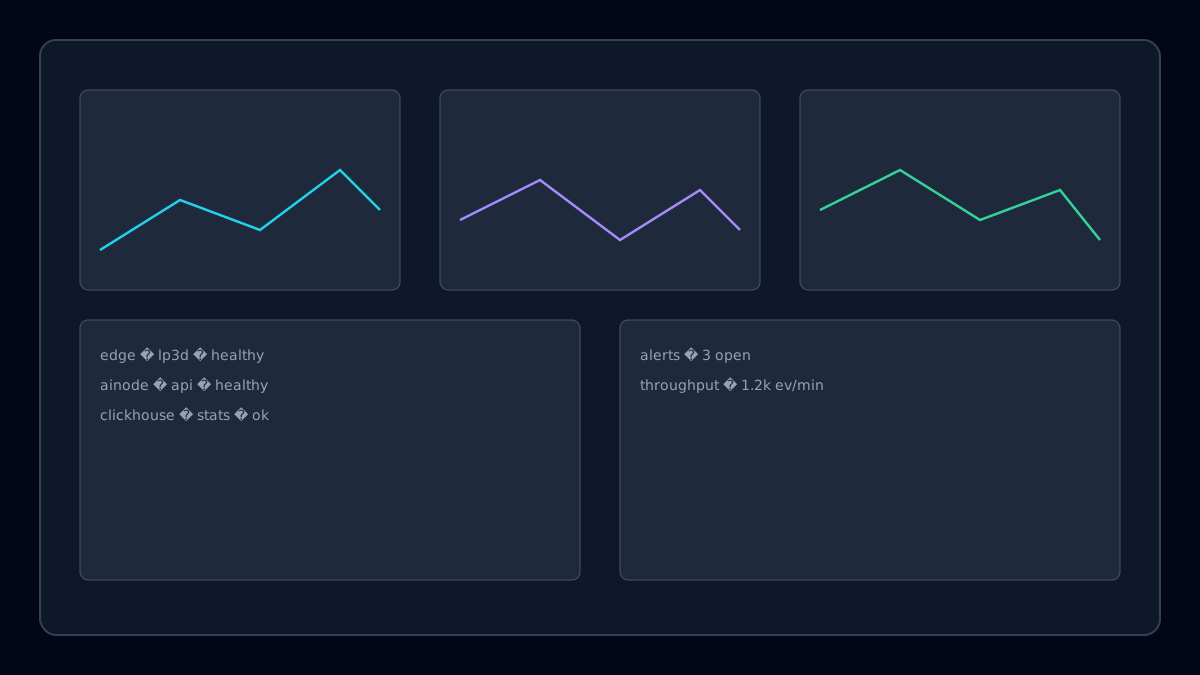
Switch between the live sensor dashboard and InfraVero Intelligence to see how operators work with their data day to day.
Try the demoWhat you get in the box
Three capabilities that define the operator job. Everything else supports them.
Live dashboards
Charts and tables refresh as events arrive. Slice by site, asset, or time range, no exports required.
Fewer tabs, faster decisions.
InfraVero Intelligence
Ask in plain language; every answer cites the sensors, time windows, and readings behind it. It also explains why an alert fired, and when something needs changing it proposes the change for you to confirm, never acting on its own.
Investigations in minutes, decisions still yours.
Vision on the same timeline
On-site object detection and tracking on every camera stream. A detected event and a sensor anomaly land on one incident timeline, not two screens you reconcile by hand.
One workspace for the full picture.
More building blocksShow
Unified ingestion
Sensor telemetry and camera streams feed into a single pipeline, so live readings and video share one history.
Connect once, query everything.
Identity and access control
Role-based visibility with multi-factor authentication and an exportable audit trail. Access scoping is pilot-grade today, with per-site controls expanding.
Security you can explain in a review.
Web, mobile, and push
Same account and data in the browser, on a field tablet, or through mobile push notifications. Remote access uses encrypted tunnels instead of opening your network.
Consistent view from control room to field.
Runs on-site, hardware included
NTALabs specs, supplies, and installs the compute, sized to your site: a compact appliance, an edge stack, or a hybrid layout. Your data stays in your environment.
No mandatory third-party data path.
Action-ready alerts
Route alerts through approved workflows with the context operators need to acknowledge, escalate, or investigate without opening unnecessary access.
Right alert, right person, right moment.
Encrypted and auditable
Sensitive configuration stays encrypted at rest. Logins, sessions, and access changes are logged into an audit trail you can export in a review.
Audit trails you can export in a review.
Open integration
Sensor telemetry and camera streams work today. Programmatic access and broader industrial integrations are scoped per pilot, not claimed as vaporware.
Adopt without freezing your stack.
How InfraVero Intelligence decides
Specific, not a black box. The parts of the AI layer a technical buyer asks about.
Checks have to agree
An alert only escalates when several independent checks agree on it, not one model guessing. It also catches patterns that have never occurred before, not just threshold breaches.
Every alert explains itself
Ask why an alert fired and you get the reason in plain language, built from the same evidence behind it: which checks agreed, how strongly, against what baseline.
It proposes, you confirm
When something needs changing, acknowledging an alert or adjusting an alert rule, InfraVero Intelligence shows you the before and after and waits. Nothing is applied until you click confirm, and every change is logged.
What's next Short-horizon forecasts with a calibrated confidence range, and alerting that tunes itself to each asset's own normal over time, are built and roll out per deployment. See the trust center for what is shipped today versus scoped per pilot.
Under the hood
You do not have to think about any of this to use InfraVero, but it is what lets the operator surface stay fast and honest.
Tiered storage
Recent data stays instantly available for live dashboards; older history moves to cheaper long-term storage, so an InfraVero Intelligence question can still reach back weeks without a cost spike.
End-to-end vision
Camera feeds run through real-time object detection and tracking, and land as clips and snapshots tied to the same incidents your sensors raise, not a separate camera silo.
Automated daily reports
A scheduled job compiles KPIs and charts into a daily brief for leadership, so the digest arrives without anyone building it by hand.
See the architecture for how the tiers connect, or the trust center for what is shipped today versus scoped per pilot.
What survives a real pilot
Themes IT, OT, and leadership probe before they standardize: custody, fit-for-purpose deployment, coexistence, and explainable AI.
Security that survives a review
Signed-in users, least-privilege access, stepped verification, and audit trails that tie every action back to an account. IT and GRC teams can see exactly how the system behaves, no "trust us" required.
Remote access runs through encrypted tunnels rather than open ports. Optional intrusion detection is available in the deployment. Sensitive configuration stays encrypted at rest, and operators use the same identity model whether they are on-site or remote.
Verify in week one
- Walk through who can see which sites, assets, and cameras.
- Export audit-relevant events for a sample workflow and verify the trail.
Deployment that fits your estate
InfraVero runs close to the assets: a compact on-site appliance, a regional edge node, or a hybrid layout where only the control plane leaves your network boundary. No cloud dependency for core operations.
Ingestion, analytics, dashboards, video, and InfraVero Intelligence are separate services that scale independently. NTALabs sizes and supplies the deployment to match the site, not the other way around. Core operations keep running on-site if the internet drops; remote access resumes with the tunnel.
Verify in week one
- Map one site to a sizing sketch based on connectivity and retention needs.
- Confirm where raw operational data stops relative to any external paths.
Adopt without replacing what works
Most teams already run historians, building management systems, or cloud point solutions. InfraVero is the consolidation layer, bringing scattered signals into one surface with open integration patterns and room to grow.
Start with a narrow slice, one building, one line, one campus. Expand dashboards, alerts, and assistant capabilities as operators gain confidence. No big-bang migration is needed to prove value.
Verify in week one
- Land the first dozen signals and one dashboard your team will actually open daily.
- Identify one downstream system (ticketing, CMMS, chat) for a lightweight integration.
Answers point back to evidence
When a chart spikes or InfraVero Intelligence summarizes a shift, stakeholders can ask "why?" and land on timestamps, sensors, and time windows, not a confidence score. That traceability is what makes AI usable in regulated and safety-conscious environments.
Dashboards, alerts, and plain-language Q&A draw from the same durable history. The result: faster investigations, fewer side-channel spreadsheets, and no more screenshot archaeology.
Verify in week one
- Reproduce one incident narrative from alert through to the underlying readings.
- Ask InfraVero Intelligence a question and verify the time range and sources it used.
Transparency that survives audits
Dashboards and InfraVero Intelligence are views on durable records, so when leadership asks for proof, you are not reconstructing history from screenshots.
Signal arrives
Devices and systems emit readings and events.
Durable record
Data is stored with timestamps for later review.
Explainable views
Dashboards and answers point back to those records.
Pilot with NTALabs
Typical first slice: a dozen sensors plus one daily dashboard on a compact appliance we install, in about 2-4 weeks.
We help teams scope hardware, connectivity, and onboarding so the first production slice is small, measured, and easy to defend internally.
Start a pilot